
Why Your Sales Funnel Is Broken (And the Fix Is Simpler Than You Think)
Most local businesses don't have a funnel. They have a wish — and a social media account.
MARKETING AUTOMATION
Bold Content Studio
5/8/20264 min read
Here's a question most business owners can't answer confidently:
If a stranger discovered your business today — a TikTok, a Google search, a referral — what happens next?
Not what you hope happens. What actually, predictably, systematically happens?
For most local service businesses, the honest answer is: nothing. Or worse — someone on your team tries to remember to follow up, misses the window, and the lead quietly disappears into the void.
That's not a marketing problem. That's a funnel problem. And it's costing you more than you realise.
What a Funnel Actually Is
Forget the marketing jargon for a second. A funnel is just this: a clear, structured path that takes someone from "I've never heard of you" to "here's my credit card."
Every step of that journey should be intentional. Every handoff should be automatic. Every follow-up should happen whether you're in a client meeting, on holiday, or asleep.
That's it. That's the whole idea.
"Content without a funnel is a hobby. Content with a funnel is a business."
Most businesses have the content part figured out — or at least they're trying. They're posting on Instagram. Maybe running some ads. Maybe even getting decent engagement. But without a funnel connected to that content, all that effort is producing awareness with no conversion path. You're filling a bucket with a hole in it.
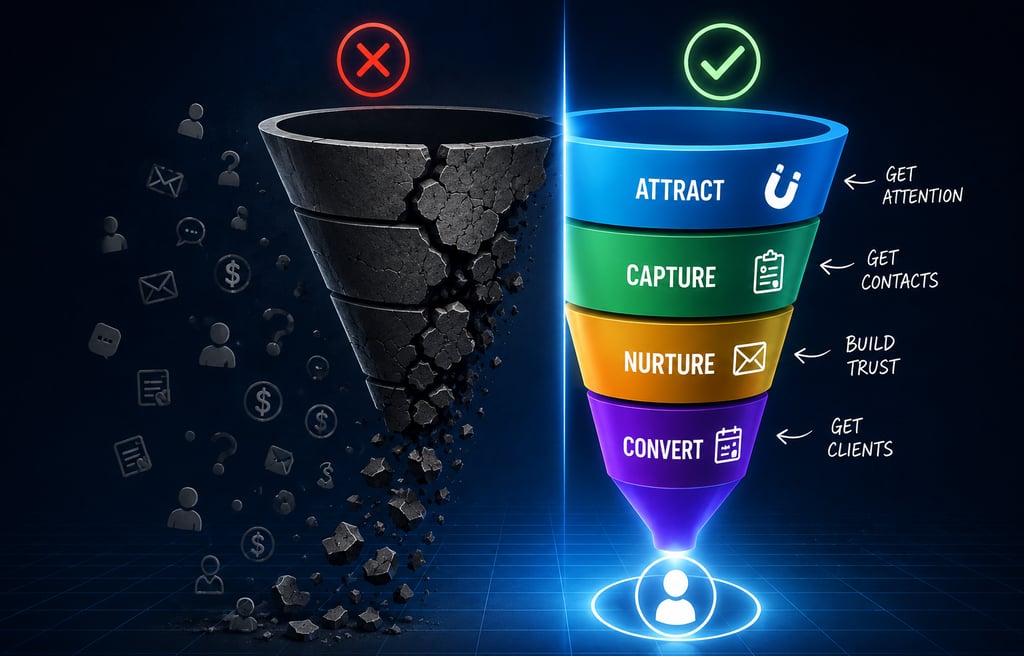
The 4 Stages Every Funnel Needs
Stage 1 — Attract. This is where someone first encounters your brand. A short-form video. A Google search result. A Facebook ad. The goal here isn't to sell — it's to earn attention. The content that works best at this stage answers real questions your ideal clients are already asking.
Stage 2 — Capture. Once someone is interested, you need a way to stay in touch. A lead magnet. A booking form. An email opt-in. If someone visits your website and leaves without giving you their contact details, they're probably gone forever. This stage is about creating a reason to stay connected.
Stage 3 — Nurture. This is where most businesses fall completely flat. A lead comes in, gets one follow-up email (maybe), and then hears nothing. Meanwhile, your competitor is sending a five-email sequence that builds trust, answers objections, and positions them as the obvious choice. Nurture is the difference between a cold lead and a warm one.
Stage 4 — Convert. The call. The proposal. The booking. By the time someone reaches this stage in a well-built funnel, they've already decided they want to work with you. You're not convincing them — you're just making it easy to say yes.
79% of leads never convert due to lack of follow-up
6-8 touchpoints needed before a lead is ready to buy
21x higher conversions when responding within 5 minutes
A Real Example: The Plumbing Company That Stopped Chasing Leads
A plumbing company based in Dublin was spending €1,500 a month on Facebook ads. The ads were decent. The targeting was reasonable. But their cost-per-booking was sky high, and the owner couldn't figure out why.
The problem wasn't the ads. It was what happened after someone clicked.
The ad sent traffic to a generic homepage. No clear offer. No lead form. No follow-up. Interested people clicked, looked around, got confused, and left.
After building a proper funnel — a landing page with a specific offer, an instant email confirmation, a three-part nurture sequence, and an automated booking link — their cost-per-booking dropped by 60% within six weeks. Same ad budget. Completely different result.
The ads didn't change. The funnel did.
Why Most Businesses Don't Have This
It's not laziness. It's not lack of ambition. It's usually one of three things:
They don't know where to start. The word "funnel" sounds technical and overwhelming. It doesn't have to be. Start with one entry point and one follow-up sequence. That's a funnel.
They think it requires expensive software. It doesn't. You need a landing page, an email tool, and a calendar link. That's it. Most businesses already have two of the three.
They're too busy to build the thing that would make them less busy. This is the real one. And the only answer is to either carve out the time or get someone else to build it.
Your 5-Minute Funnel Audit
Ask yourself these questions right now:
When someone finds you on social media, where do they go next? Is there a clear path from your content to a conversation?
When a new lead comes in, how long before they hear from you? Is that response manual or automatic?
After first contact, do leads receive any follow-up if they don't book immediately? Or do they just fall off the radar?
Is there a single, specific action you want every visitor to take — one clear call to action across your entire digital presence?
If you answered "no" or "I'm not sure" to more than two of those, you don't have a funnel. You have a presence. And a presence without a system is just noise.
The businesses quietly winning right now aren't necessarily spending more on ads or posting more content. They've just built a system that makes every pound of ad spend and every piece of content work harder — automatically, consistently, without them having to be involved in every step.
That's what a funnel does. And it's closer than you think.
Drop a 🔥 if this hit home — or tell us which stage of your funnel is the weakest right now.
Marketing That
Works While
You Work.
Reach out anytime for marketing help.
For inquiry
inquiry@boldcontentstudio.com
© 2026. All rights reserved.