
Content Strategy for Local Businesses: How to Stop Creating and Start Compounding
Discover a proven content strategy for local businesses that turns one pillar piece into ten touchpoints. Learn how to build a content system that generates leads and compounds over time.
MARKETING AUTOMATION
Bold Content Studio
5/20/202610 min read
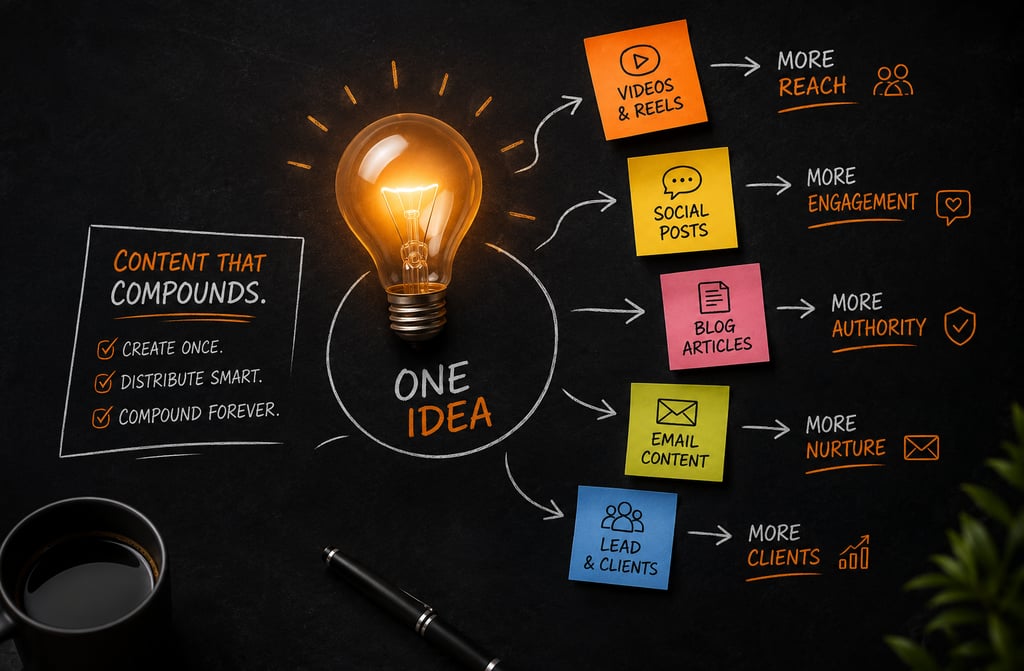
Posting more is not the answer. The businesses winning with content are not the ones creating the most. They are the ones extracting the most from what they already have and building systems that make every piece work harder over time.
Picture this. It is Sunday evening. You have a full week ahead. You sit down, open Instagram, and stare at a blank caption box for 20 minutes. You eventually write something, post it, get a handful of likes from people who already know you, and close the app feeling like you have done your marketing for the week.
Then you do the exact same thing seven days later.
If this sounds familiar, you are not alone. It is how the vast majority of local service businesses approach content. And it is one of the most expensive habits in marketing, not because of what it costs in money, but because of what it costs in time, energy, and missed opportunity.
The businesses quietly pulling ahead right now are not posting more than you. They are not hiring larger teams or spending bigger budgets. They have simply stopped treating content as a weekly chore and started treating it as a system, one that compounds in value over time, generates leads while they sleep, and turns first time viewers into paying clients without them having to be involved in every step.
This article is going to show you exactly how that system works, why most local businesses are nowhere near building it, and what you can do this week to start changing that.
"The best content you ever create should still be working for your business six months from now. If it disappears after 24 hours, you do not have a strategy. You have a habit."
Why Most Local Business Content Delivers Almost Nothing
Before we talk about what works, it is worth understanding why so much local business content fails, even when the quality is decent, the posting is consistent, and the effort is real.
The core problem is not execution. It is the absence of intent.
Most content is created to fill a schedule. Post three times a week. Stay active. Look like a real business. These are not bad instincts, but they are not a strategy. A strategy has a goal. A strategy answers the question: What do I want someone to think, feel, or do after engaging with this piece of content?
Without that answer, you are creating content for the algorithm. You are optimising for likes, reach, and engagement; metrics that feel good on a dashboard but rarely translate into bookings, enquiries, or revenue.
The second problem is distribution. Most businesses publish a piece of content on one platform and consider the job done. A post goes on Instagram. It reaches a fraction of followers for 24 to 48 hours and then disappears forever. The same idea and the same value could have reached your email list, appeared on LinkedIn, been repurposed into a short video, or been embedded into a blog post that continues generating organic search traffic for the next two years. Instead, it got 47 likes and faded.
The third problem is the missing conversion path. Content that does not lead somewhere is just entertainment. It might build awareness. It might even build affection for your brand. But if there is no clear next step, no link, no call to action, no reason for a viewer to go from passive consumer to active prospect, the content is doing brand-building work for which you will never see a direct return.
72% of marketers say content strategy is their biggest challenge
3x more leads generated by businesses with a documented content strategy
6mo average time for a blog post to reach peak organic search traffic
The Content Pyramid: One Idea, Ten Pieces of Content
The most efficient content strategy for a local service business is built on a single principle: one core piece of content becomes many. This is the idea behind what marketers call a content pyramid or content repurposing workflow, and it is the single biggest leverage point available to a time-poor business owner.
Here is how it works in practice.
Step One: Create a Pillar Piece
A pillar piece is a substantial, standalone piece of content that contains real value on its own. It is the source material for everything else. Think of a 10 to 15-minute video where you walk through a common client problem in depth. A detailed case study documenting a client’s results from start to finish. A comprehensive written guide answering the five questions every new client asks before they hire you. A sit-down interview with a long-term client about their experience working with your business.
The pillar piece does not need to be polished or expensive. It needs to be genuinely useful. The test is simple: would someone who has never heard of your business find real value in this if they stumbled across it? If the answer is yes, you have your pillar piece.
Aim to create one pillar piece per month. That is it. One piece of substantial, useful content per month is the foundation of a content strategy that will outperform most businesses posting five times a week with nothing behind it.
Step Two: Extract Short Form Clips
A 10-minute video contains at least six to eight standalone moments worth sharing as short-form content. A surprising statistic. A counterintuitive insight. A moment where you challenge conventional wisdom in your industry. A practical tip that solves a specific problem in under 60 seconds.
Each of these clips is a complete idea. Each one works as a standalone piece of content on Instagram Reels, TikTok, YouTube Shorts, or LinkedIn video. And each one points back to the full pillar piece for anyone who wants to go deeper.
This is not lazy content recycling. It is an intelligent distribution. The same idea, presented in different formats, for different audiences, at different points in their journey with your brand.
Step Three: Pull Standalone Social Posts
Every pillar piece contains five to ten quotable ideas, actionable tips, or thought-provoking observations that work as standalone social media posts. These do not require video. They do not require design. A well-written paragraph or a numbered list of insights shared as a caption on LinkedIn, Instagram, or Facebook can generate more genuine engagement than a highly produced piece of branded content.
Write them in advance. Schedule them across the month. Each one is a touchpoint that keeps your brand in front of your audience between pillar pieces without you having to start from scratch each time.
Step Four: Send It to Your Email List
Your email list is typically your most engaged audience. These are people who actively chose to stay connected with your business. They deserve your best thinking, and they are far more likely to convert into clients than a cold social media follower.
Take the core idea from your pillar piece, rewrite it in a conversational tone, and send it as an email. Not a newsletter. Not a roundup. One focused email, one valuable idea, one clear next step. This alone will keep your list warmer than 90% of local businesses that email their subscribers once every three months when they have a promotion to push.
Step Five: Publish It as a Blog Post or Article
Written content does something no social media post will ever do: it compounds in value over time through organic search. A well-optimised blog post based on your pillar piece can continue generating traffic from Google for months or years after it is published. Every month that passes, it accumulates more authority, more backlinks, and more search visibility.
Social media posts have a lifespan of 24 to 48 hours. A strong blog post has a lifespan measured in years. The businesses investing in written content now are building an asset. The businesses posting three times a week on Instagram and nothing else are building nothing that lasts.
A Second Example: The Interior Designer Who Built a Waiting List
A residential interior designer based in Dublin had a strong Instagram following, around 4,200 followers, but was converting almost none of them into enquiries. People engaged with the content, saved the posts, and left complimentary comments. But nobody was booking consultations.
The problem was not the content itself. The content was genuinely good. The problem was that there was nowhere for an interested follower to go. No link to a landing page. No lead magnet. No email sequence. No clear next step anywhere in the content or the profile.
After building a simple content system one month before and after a case study as the pillar piece, a five-email welcome sequence for new subscribers, and a consistent call to action pointing followers toward a free design consultation, the conversion picture changed dramatically within three months.
Monthly enquiries went from an average of two to three to between twelve and fifteen. A waiting list formed for the first time. The follower count barely changed. The content output barely changed. What changed was the system connecting the content to a conversion path.
This is the point most businesses miss. The content is rarely the problem. The missing system is the problem.
What a Real Content Strategy Requires
Building a content strategy that actually grows a local service business requires four things. Not ten. Not a team of specialists. Four things, done consistently.
Consistency Over Volume: One substantial piece of content per week, published consistently for six months, will outperform five pieces a week for a month, followed by three weeks of silence. Algorithms reward consistency. More importantly, audiences reward consistency. The business that shows up reliably becomes the business that feels trustworthy, and trust is what converts a follower into a client.
This does not mean you need to post every single day. It means you need a sustainable rhythm you can maintain without burning out. For most local service businesses, that means one to two pieces of primary content per week, with repurposed material filling the gaps. Start there. Build from there.
A Clear and Distinctive Point of View: The businesses that build genuine audiences are not the ones with the most polished production values. They are the ones with a perspective. What do you believe about your industry that most people in your field would not say out loud? What frustrates you about how your sector is marketed to clients? What do you know from experience that contradicts conventional wisdom?
Start there. A strong point of view is worth more than a high production budget. It is what makes someone stop scrolling, read the whole post, and remember your name the next time they need what you offer.
A Conversion Path is Attached to Every Piece of Content: Every single piece of content you produce should have a next step. A link in bio. A call to action in the caption. A prompt to reply to the email. A mention of the free consultation at the end of the video. Content without a conversion path is awareness advertising, and awareness advertising without a follow-through system is one of the most expensive ways to grow a business.
The next step does not need to be aggressive or salesy. It can simply be: “If this was useful, here is where you can go to learn more.” That single line, added consistently to every piece of content, will generate more enquiries than any individual campaign you run.
A Repurposing Workflow That Runs Automatically: This is the piece most businesses skip because it feels like overhead. But a documented repurposing workflow, even a simple checklist that takes 30 minutes after each pillar piece is created, is worth more than any individual piece of content. It is what turns one hour of creation into a month of consistent, varied, multi-platform distribution.
It does not need to be complicated. It needs to be documented, delegated, or automated. Once the workflow exists, the hard creative work of coming up with ideas becomes the smallest part of your content operation.
The Platforms That Matter Most for Local Service Businesses
Not every platform deserves equal attention. The right content strategy for a local service business is built around the platforms where your specific clients actually spend their time and where the format suits the way you naturally communicate.
Short-Form Video on Instagram Reels, TikTok, and YouTube Shorts currently offers the highest organic reach of any content format. If you are comfortable on camera, even briefly, this is the single highest return on investment format available to a local business right now. The barrier to entry is low. The competition from other local businesses is still surprisingly thin. And the compound effect of a consistent short-form video presence builds brand recognition faster than almost any other channel.
LinkedIn is significantly underused by local service businesses. Most local businesses assume LinkedIn is only relevant for B2B companies. That assumption is costing them. The decision makers who commission local services, property developers, practice managers, and business owners commissioning commercial fit-outs are overwhelmingly active on LinkedIn. Written posts, case studies, and short video content on LinkedIn reach a professional audience that is actively looking to invest in quality service providers.
Email remains the highest converting channel for turning warm leads into paying clients, as we explored in a previous article. Your content strategy should feed your email list consistently, and your email list should be the first audience to receive your best content, before it goes anywhere else.
SEO and Written Content are the long game, and most local businesses are not playing it at all. A consistently updated blog or articles section on your website, built around the questions your ideal clients are searching for, will generate compounding organic traffic that pays dividends for years. Every article you publish is a door into your business. The more doors you build, the more people find you without you having to pay for the introduction.
Your 90 Day Content Strategy Starting Point
You do not need to build everything at once. The businesses that try to launch a full content system in a week burn out before they see results. The businesses that build one piece of the system at a time, consistently, are the ones still running that system two years later when the compounding effect becomes impossible to ignore.
Here is a practical 90-day starting point.
Days one to thirty: Pick one platform where your ideal clients are most active. Commit to one pillar piece per week: a video, a detailed post, or a written article. Do not repurpose yet. Do not optimise yet. Just create consistently and develop the habit of producing content that has a clear purpose and a clear next step.
Days thirty-one to sixty: Introduce the repurposing workflow. Take each pillar piece and extract at least three additional pieces of content from it. A short clip. A social caption. An email. You are now producing four pieces of content from the effort of one. Track which formats generate the most engagement and enquiries.
Days sixty-one to ninety: Add a second platform and introduce written content for SEO. Publish one blog post per month based on your best-performing pillar piece. Connect your content to a lead capture mechanism, a landing page, an email opt-in, or a direct booking link and start measuring conversion, not just engagement.
✓ One pillar piece of content created per month
✓ A repurposing workflow that extracts 8 to 10 pieces from each pillar
✓ One blog post published per month for long term SEO
✓ A consistent call to action on every piece of content
✓ An email sequence connected to your content for lead nurturing
✓ Monthly review of what is generating enquiries versus what is generating likes
The local businesses building real, sustainable growth through content right now are not the ones posting the most. They are not the ones with the largest teams or the most polished production. They are the ones who made a decision to stop treating content as a weekly chore and start treating it as a system one that compounds, one that connects to a conversion path, and one that works for the business long after the original piece was created.
That system is not complicated to build. It is not expensive to run. And the window to build it before your local competitors do is still very much open.
Start with one pillar piece. Build the repurposing habit around it. Connect it to something that converts. Then do it again next month.
That is the whole strategy. Everything else is detail.
What does your current content process look like?
Book a Strategy Call ↗
Marketing That
Works While
You Work.
Reach out anytime for marketing help.
For inquiry
inquiry@boldcontentstudio.com
© 2026. All rights reserved.